Hearing infrasound is not a matter of "putting up a microphone". The signals are weak, the background is enormous, and the main enemy is the wind. Over the decades a coherent technology has taken shape, and its core is the international network created to monitor nuclear tests.
A network that listens to the whole planet
The Comprehensive Nuclear-Test-Ban Treaty Organization (CTBTO) has deployed the International Monitoring System (IMS) — dozens of infrasound stations around the world, operating continuously.1 It was this system that caught the Chelyabinsk meteor and the wave from Tonga,2 and earlier still the infrasound from the 2004 Sumatra tsunami.3 Its direct purpose is to catch nuclear explosions: the infrasound of North Korea's 2017 underground test was recorded by a station 400 km away.6 And today infrasound is routinely used to track volcanoes around the world.7 Operational infrasonic early-warning systems already exist for explosive volcanic eruptions (Ripepe et al., 2018)12 — for example, the dense seismo-acoustic network that warned of the 2019 paroxysmal Stromboli eruptions (Ripepe et al., 2021).13
The microbarometer and the array
The heart of a station is the microbarometer, an instrument that measures minute pressure fluctuations (fractions of a pascal). A single sensor says little, so they are combined into an array: several instruments a few hundred metres apart. By comparing the fractions of a second by which a wave arrives at different sensors, one can work out where it came from and at what speed — and so tell a real event from random noise.
The main enemy is the wind
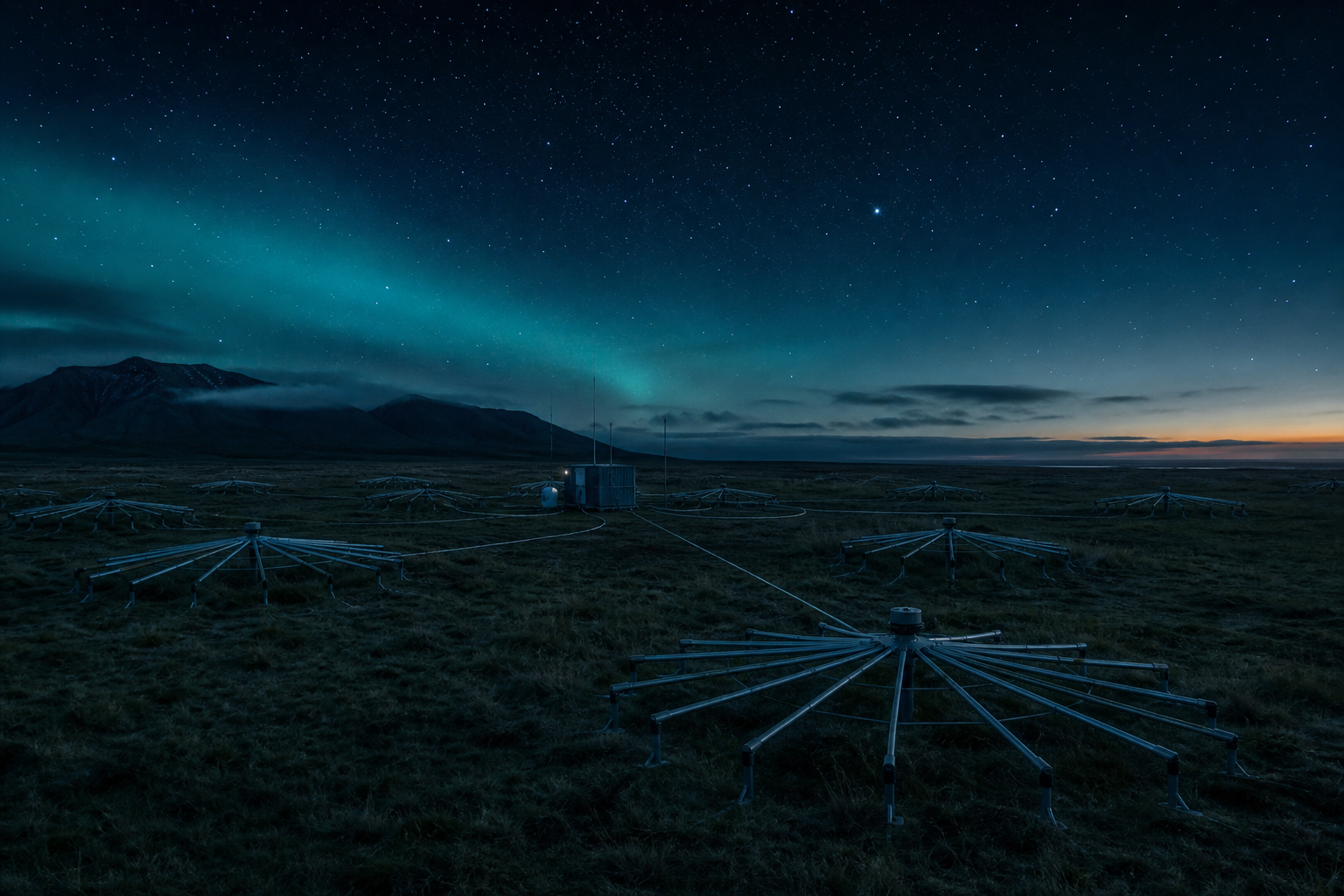
Wind turbulence creates false "pressure noise" right at the sensor. To suppress it, each instrument is fitted with pipe arrays (wind-noise rosettes): they average the pressure over an area and damp local gusts, leaving the coherent wave. This is one of the key pieces of field-infrasound know-how: measurements show that an 18 m diameter rosette reduces wind noise by 15–20 dB.5
Signal versus weather noise
Wind is not the only deception. A passing atmospheric front produces a coherent pressure change across many stations — exactly what the algorithm is looking for, so telling geophysical infrasound from weather noise is a real scientific problem. It is not solved "by eye": the array-correlation method PMCC checks whether the delays between sensors are consistent with a single plane wave, and discards what is not.8 Large analyses of IMS data show how, in practice, to distinguish incoherent wind noise from "spurious" coherent signals and how to compute the network's real detection capability.9 Modern arrays increasingly use machine learning and deep learning to categorize infrasound signals (Bishop et al., 2022).10
- Infrasound arrays of 4–5 sensors operationally catch avalanches several kilometres away in any weather.4
- The same methods are applied to volcanoes, bolides and explosion monitoring.
- Correlation algorithms (for example, PMCC) automatically find a signal in a continuous data stream.8
- An earthquake was "heard" for the first time from a stratospheric balloon by its acoustic signature (Brissaud et al., 2021) — a prototype for networks of balloon sensors.11
Big science has proven the principle on expensive stations. Our task is to carry the same ideas (arrays, wind filtering, correlation) over to cheap nodes and win by numbers. That's what the next article is about →
Sources for this article
These sources are part of the full HERD library — 363 vetted sources, with meaning search and topic filters.
- organization CTBTO. Infrasound monitoring (International Monitoring System). ctbto.org
- peer-reviewed Matoza R.S. et al. (2022). Global seismoacoustic observations of the January 2022 Hunga eruption, Tonga. Science 377. science.org
- peer-reviewed Le Pichon A. et al. (2005). Infrasound associated with 2004–2005 Sumatra earthquakes and tsunami. GRL 32. agupubs.wiley.com
- peer-reviewed Marchetti E. et al. (2015). Infrasound array detection and front velocity of snow avalanches. NHESS 15. nhess.copernicus.org
- peer-reviewed Hedlin M.A.H., Alcoverro B., D'Spain G. (2003). Evaluation of rosette infrasonic noise-reducing spatial filters. J. Acoust. Soc. Am. 114(4). doi.org
- peer-reviewed Assink J.D., Averbuch G., Shani-Kadmiel S., Smets P., Evers L. (2018). A seismo-acoustic analysis of the 2017 North Korean nuclear test. Seismol. Res. Lett. 89(6). geoscienceworld.org
- peer-reviewedreview Fee D., Matoza R.S. (2013). An overview of volcano infrasound: from Hawaiian to Plinian, local to global. J. Volcanol. Geotherm. Res. 249. doi.org
- peer-reviewed Cansi Y. (1995). An automatic seismic event processing for detection and location: the PMCC method. GRL 22(9). doi.org
- peer-reviewed Vergoz J. et al. (2022). IMS infrasound data products for atmospheric studies and civilian applications. Earth Syst. Sci. Data 14. essd.copernicus.org
- peer-reviewed Bishop J.W. et al. (2022). Deep learning categorization of infrasound array data. JASA 152(4). doi.org
- peer-reviewed Brissaud Q. et al. (2021). The first detection of an earthquake from a balloon using its acoustic signature. GRL 48. doi.org
- peer-reviewed Ripepe M. et al. (2018). Infrasonic early warning system for explosive eruptions. JGR Solid Earth 123. doi.org
- peer-reviewed Ripepe M. et al. (2021). Dense seismo-acoustic network warning of the 2019 paroxysmal Stromboli eruptions. Sci. Rep. 11. doi.org
- review Christie D.R., Campus P. (2010). The IMS Infrasound Network: Design and Establishment of Infrasound Stations. In: Infrasound Monitoring for Atmospheric Studies (Springer). doi.org
- review Marty J. (2019). The IMS Infrasound Network: Current Status and Technological Developments. In: Infrasound Monitoring for Atmospheric Studies, 2nd ed. (Springer). doi.org
- review Brachet N., Brown D., Le Bras R., Cansi Y., Mialle P., Coyne J. (2010). Monitoring the Earth's Atmosphere with the Global IMS Infrasound Network. In: Infrasound Monitoring for Atmospheric Studies (Springer). doi.org
- peer-reviewed Green D.N., Bowers D. (2010). Estimating the detection capability of the International Monitoring System infrasound network. Journal of Geophysical Research: Atmospheres 115(D18). doi.org
- peer-reviewed Le Pichon A., Ceranna L., Vergoz J. (2012). Incorporating numerical modeling into estimates of the detection capability of the IMS infrasound network. Journal of Geophysical Research: Atmospheres 117(D5). doi.org
- peer-reviewed Le Pichon A. et al. (2015). Incorporating atmospheric uncertainties into estimates of the detection capability of the IMS infrasound network. The Journal of the Acoustical Society of America 137(3). doi.org
- peer-reviewed Matoza R.S. et al. (2017). Automated detection and cataloging of global explosive volcanism using the International Monitoring System infrasound network. Journal of Geophysical Research: Solid Earth 122(4). doi.org
- peer-reviewed Ceranna L., Le Pichon A., Green D.N., Mialle P. (2009). The Buncefield explosion: a benchmark for infrasound analysis across Central Europe. Geophysical Journal International 177(2). doi.org
- peer-reviewed Ottemoller L., Evers L.G. (2008). Seismo-acoustic analysis of the Buncefield oil depot explosion in the UK, 2005 December 11. Geophysical Journal International 172(3). doi.org
- peer-reviewed Evers L.G., Siegmund P. (2009). Infrasonic signature of the 2009 major sudden stratospheric warming. Geophysical Research Letters 36(23). doi.org
- peer-reviewed Bowman D.C., Albert S.A. (2018). Acoustic event location and background noise characterization on a free-flying infrasound sensor network in the stratosphere. Geophysical Journal International 213(3). doi.org
- review Johnson J.B. (2019). Local Volcano Infrasound Monitoring. In: Infrasound Monitoring for Atmospheric Studies, 2nd ed. (Springer). doi.org
- review Le Pichon A., Blanc E., Hauchecorne A. (eds.) (2019). Infrasound Monitoring for Atmospheric Studies (2nd ed.). Springer, Cham. doi.org
- organization EarthScope Consortium (formerly IRIS) (2024). EarthScope Consortium - seismic and infrasound facilities and open data (SAGE). earthscope.org. earthscope.org
- organization EarthScope / IRIS Data Management Center (2024). IRIS DMC (EarthScope) data services - open seismological and infrasound waveform archive. ds.iris.edu. ds.iris.edu
HERD (2026). How infrasound is captured. HERD — Infrasound library. https://theherd.network/infrasound/en/monitoring