超低周波音を聴き取ることは、「マイクを立てる」だけの話ではありません。信号は弱く、背景は膨大で、最大の敵は風です。何十年もかけて一貫した技術が形づくられてきましたが、その中核は、核実験を監視するために作られた国際的なネットワークです。
地球全体を聴くネットワーク
包括的核実験禁止条約機関(CTBTO)は、国際監視制度(IMS) — 世界中に配置され、絶え間なく稼働する数十の超低周波音観測所 — を展開しています。1 チェリャビンスクの隕石やトンガからの波を捉えたのもこのシステムであり、2 さらにさかのぼれば 2004 年スマトラ津波の超低周波音も記録しました。3 その直接の目的は核爆発を捉えることで、2017 年の北朝鮮の地下実験の超低周波音は 400 km 離れた観測所で記録されました。6 そして今日、超低周波音は世界中の火山を追跡するために日常的に用いられています。7 爆発的な火山噴火に対する実用的な超低周波音の早期警報システムはすでに存在し(Ripepe et al., 2018)、12 たとえば 2019 年のストロンボリの激しい噴火を警告した稠密な地震音響ネットワークがその例です(Ripepe et al., 2021)。13
マイクロバロメータとアレイ
観測所の心臓部はマイクロバロメータ、すなわちごく微細な圧力の変動(パスカルの何分の一)を測定する機器です。一つのセンサーだけでは多くを語れないため、それらはアレイとして組み合わされます。すなわち、数百メートル離して置かれた複数の機器です。波が異なるセンサーに到達する数分の一秒の差を比較することで、波がどこから、どれくらいの速さで来たのかを割り出すことができ、こうして本物の現象を偶然の雑音と見分けられます。
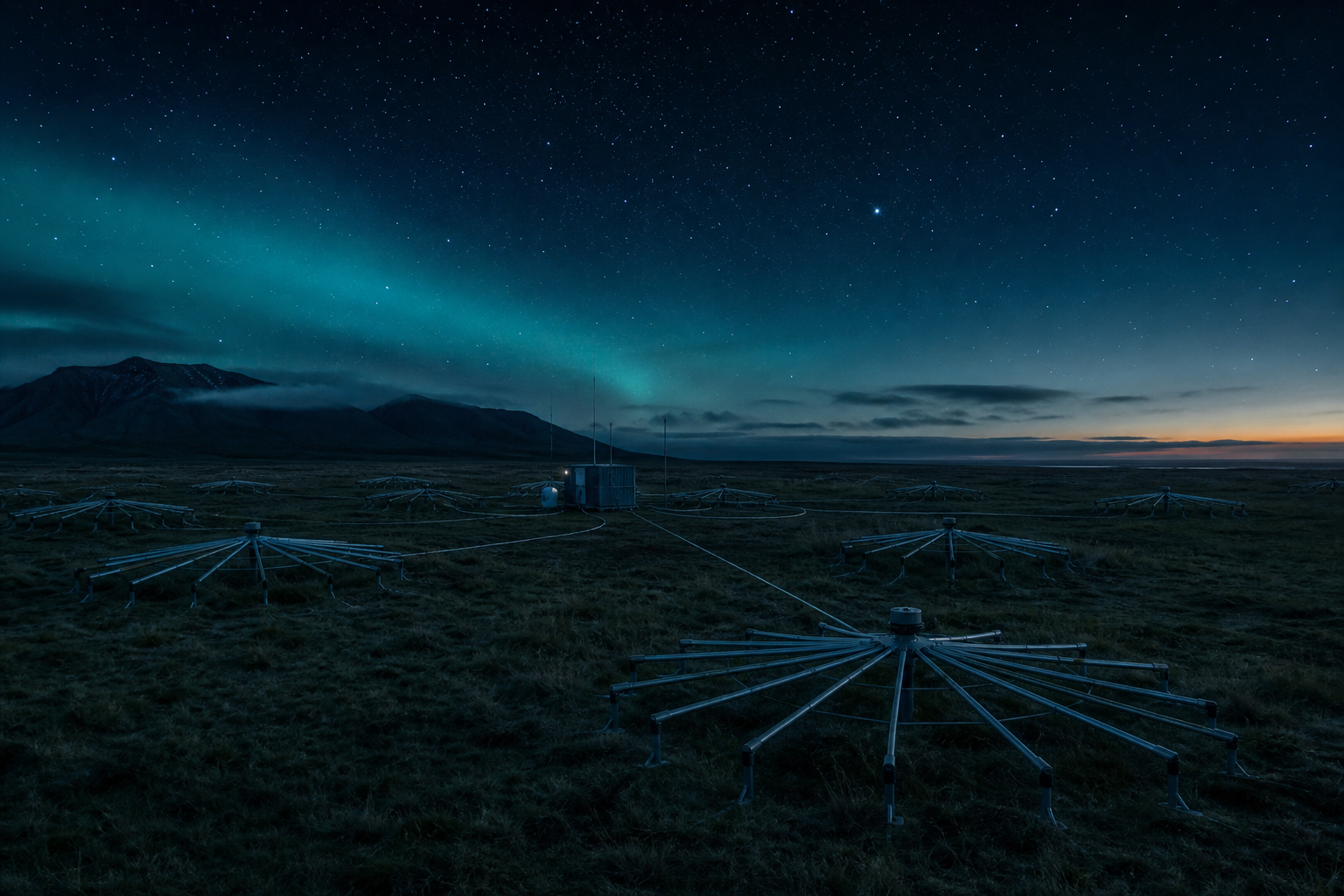
最大の敵は風
風の乱れは、まさにセンサーのところで偽の「圧力雑音」を生み出します。これを抑えるため、各機器にはパイプアレイ(風雑音用ロゼット)が取り付けられます。これらは一定の範囲で圧力を平均化し、局所的な突風を減衰させて、コヒーレントな波だけを残します。これは野外での超低周波音計測における鍵となるノウハウの一つです。計測によれば、直径 18 m のロゼットは風雑音を 15〜20 dB 低減します。5
信号と気象雑音の対決
欺くのは風だけではありません。通過する気象前線は、多くの観測所にわたってコヒーレントな圧力変化を生み出します — まさにアルゴリズムが探しているものなので、地球物理学的な超低周波音を気象雑音と見分けることは、実際に難しい科学の問題です。これは「目で見て」解決できるものではありません。アレイ相関手法 PMCC は、センサー間の遅延が単一の平面波と整合するかどうかを確かめ、そうでないものを捨てます。8 IMS データの大規模な解析は、コヒーレントでない風雑音を「偽の」コヒーレント信号から実際にどう区別するか、そしてネットワークの真の検知能力をどう計算するかを示しています。9 現代のアレイは、超低周波音信号の分類に機械学習や深層学習をますます活用しています(Bishop et al., 2022)。10
大規模科学は、高価な観測所でこの原理を証明してきました。私たちの課題は、同じ発想(アレイ、風のフィルタリング、相関)を安価なノードに移し、数で勝つことです。それが次の記事のテーマです →
この記事の出典
これらの出典はHERD の全ライブラリ(363件の検証済み出典)の一部です。意味検索とトピック絞り込みに対応。
- 機関 CTBTO. Infrasound monitoring (International Monitoring System). ctbto.org
- 査読あり Matoza R.S. et al. (2022). Global seismoacoustic observations of the January 2022 Hunga eruption, Tonga. Science 377. science.org
- 査読あり Le Pichon A. et al. (2005). Infrasound associated with 2004–2005 Sumatra earthquakes and tsunami. GRL 32. agupubs.wiley.com
- 査読あり Marchetti E. et al. (2015). Infrasound array detection and front velocity of snow avalanches. NHESS 15. nhess.copernicus.org
- 査読あり Hedlin M.A.H., Alcoverro B., D'Spain G. (2003). Evaluation of rosette infrasonic noise-reducing spatial filters. J. Acoust. Soc. Am. 114(4). doi.org
- 査読あり Assink J.D., Averbuch G., Shani-Kadmiel S., Smets P., Evers L. (2018). A seismo-acoustic analysis of the 2017 North Korean nuclear test. Seismol. Res. Lett. 89(6). geoscienceworld.org
- 査読あり総説 Fee D., Matoza R.S. (2013). An overview of volcano infrasound: from Hawaiian to Plinian, local to global. J. Volcanol. Geotherm. Res. 249. doi.org
- 査読あり Cansi Y. (1995). An automatic seismic event processing for detection and location: the PMCC method. GRL 22(9). doi.org
- 査読あり Vergoz J. et al. (2022). IMS infrasound data products for atmospheric studies and civilian applications. Earth Syst. Sci. Data 14. essd.copernicus.org
- 査読あり Bishop J.W. et al. (2022). Deep learning categorization of infrasound array data. JASA 152(4). doi.org
- 査読あり Brissaud Q. et al. (2021). The first detection of an earthquake from a balloon using its acoustic signature. GRL 48. doi.org
- 査読あり Ripepe M. et al. (2018). Infrasonic early warning system for explosive eruptions. JGR Solid Earth 123. doi.org
- 査読あり Ripepe M. et al. (2021). Dense seismo-acoustic network warning of the 2019 paroxysmal Stromboli eruptions. Sci. Rep. 11. doi.org
- レビュー Christie D.R., Campus P. (2010). The IMS Infrasound Network: Design and Establishment of Infrasound Stations. In: Infrasound Monitoring for Atmospheric Studies (Springer). doi.org
- レビュー Marty J. (2019). The IMS Infrasound Network: Current Status and Technological Developments. In: Infrasound Monitoring for Atmospheric Studies, 2nd ed. (Springer). doi.org
- レビュー Brachet N., Brown D., Le Bras R., Cansi Y., Mialle P., Coyne J. (2010). Monitoring the Earth's Atmosphere with the Global IMS Infrasound Network. In: Infrasound Monitoring for Atmospheric Studies (Springer). doi.org
- 査読あり Green D.N., Bowers D. (2010). Estimating the detection capability of the International Monitoring System infrasound network. Journal of Geophysical Research: Atmospheres 115(D18). doi.org
- 査読あり Le Pichon A., Ceranna L., Vergoz J. (2012). Incorporating numerical modeling into estimates of the detection capability of the IMS infrasound network. Journal of Geophysical Research: Atmospheres 117(D5). doi.org
- 査読あり Le Pichon A. et al. (2015). Incorporating atmospheric uncertainties into estimates of the detection capability of the IMS infrasound network. The Journal of the Acoustical Society of America 137(3). doi.org
- 査読あり Matoza R.S. et al. (2017). Automated detection and cataloging of global explosive volcanism using the International Monitoring System infrasound network. Journal of Geophysical Research: Solid Earth 122(4). doi.org
- 査読あり Ceranna L., Le Pichon A., Green D.N., Mialle P. (2009). The Buncefield explosion: a benchmark for infrasound analysis across Central Europe. Geophysical Journal International 177(2). doi.org
- 査読あり Ottemoller L., Evers L.G. (2008). Seismo-acoustic analysis of the Buncefield oil depot explosion in the UK, 2005 December 11. Geophysical Journal International 172(3). doi.org
- 査読あり Evers L.G., Siegmund P. (2009). Infrasonic signature of the 2009 major sudden stratospheric warming. Geophysical Research Letters 36(23). doi.org
- 査読あり Bowman D.C., Albert S.A. (2018). Acoustic event location and background noise characterization on a free-flying infrasound sensor network in the stratosphere. Geophysical Journal International 213(3). doi.org
- レビュー Johnson J.B. (2019). Local Volcano Infrasound Monitoring. In: Infrasound Monitoring for Atmospheric Studies, 2nd ed. (Springer). doi.org
- レビュー Le Pichon A., Blanc E., Hauchecorne A. (eds.) (2019). Infrasound Monitoring for Atmospheric Studies (2nd ed.). Springer, Cham. doi.org
- 機関 EarthScope Consortium (formerly IRIS) (2024). EarthScope Consortium - seismic and infrasound facilities and open data (SAGE). earthscope.org. earthscope.org
- 機関 EarthScope / IRIS Data Management Center (2024). IRIS DMC (EarthScope) data services - open seismological and infrasound waveform archive. ds.iris.edu. ds.iris.edu
HERD (2026). 超低周波音はどう捉えられるか. HERD — インフラサウンド・ライブラリ. https://theherd.network/infrasound/ja/monitoring