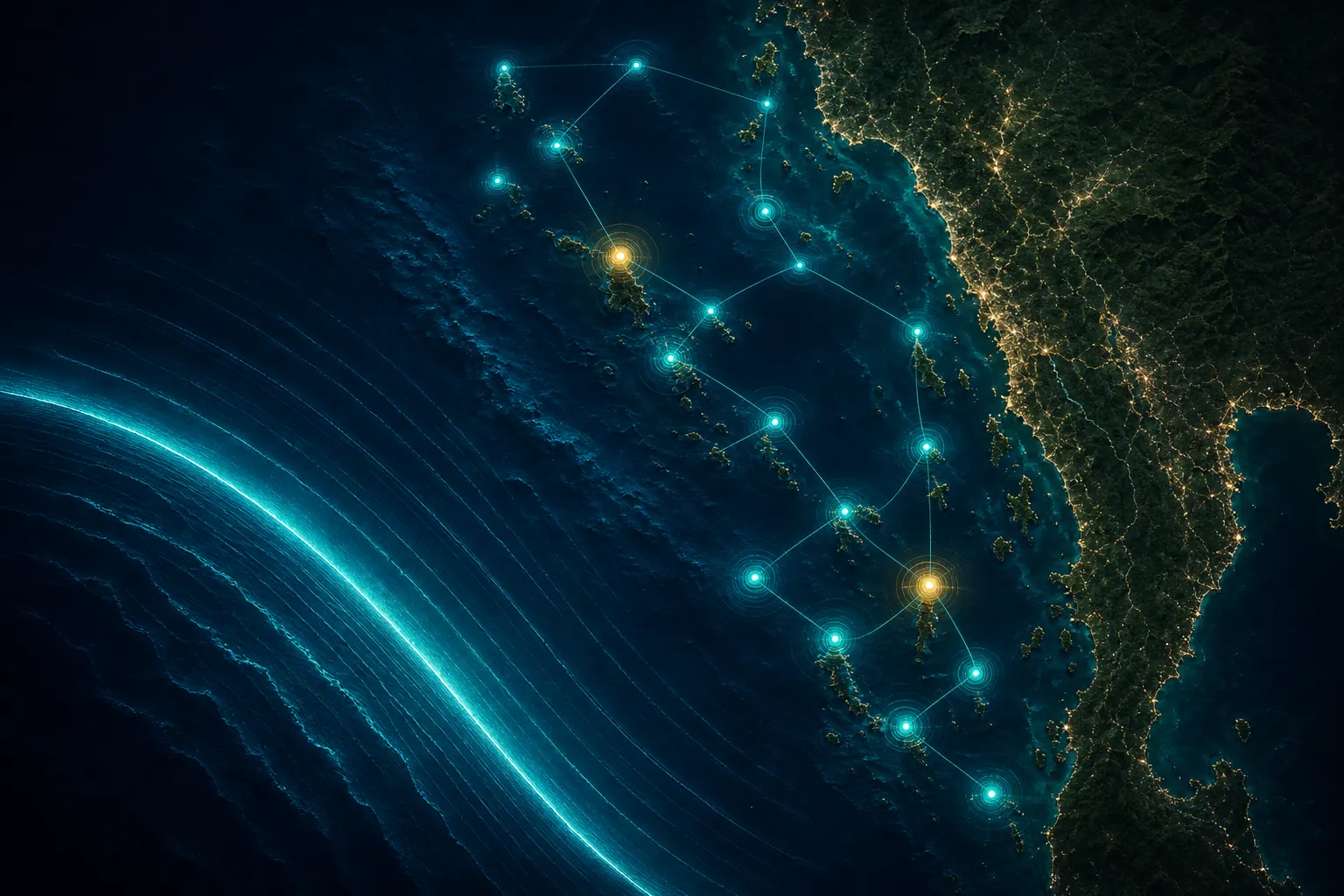
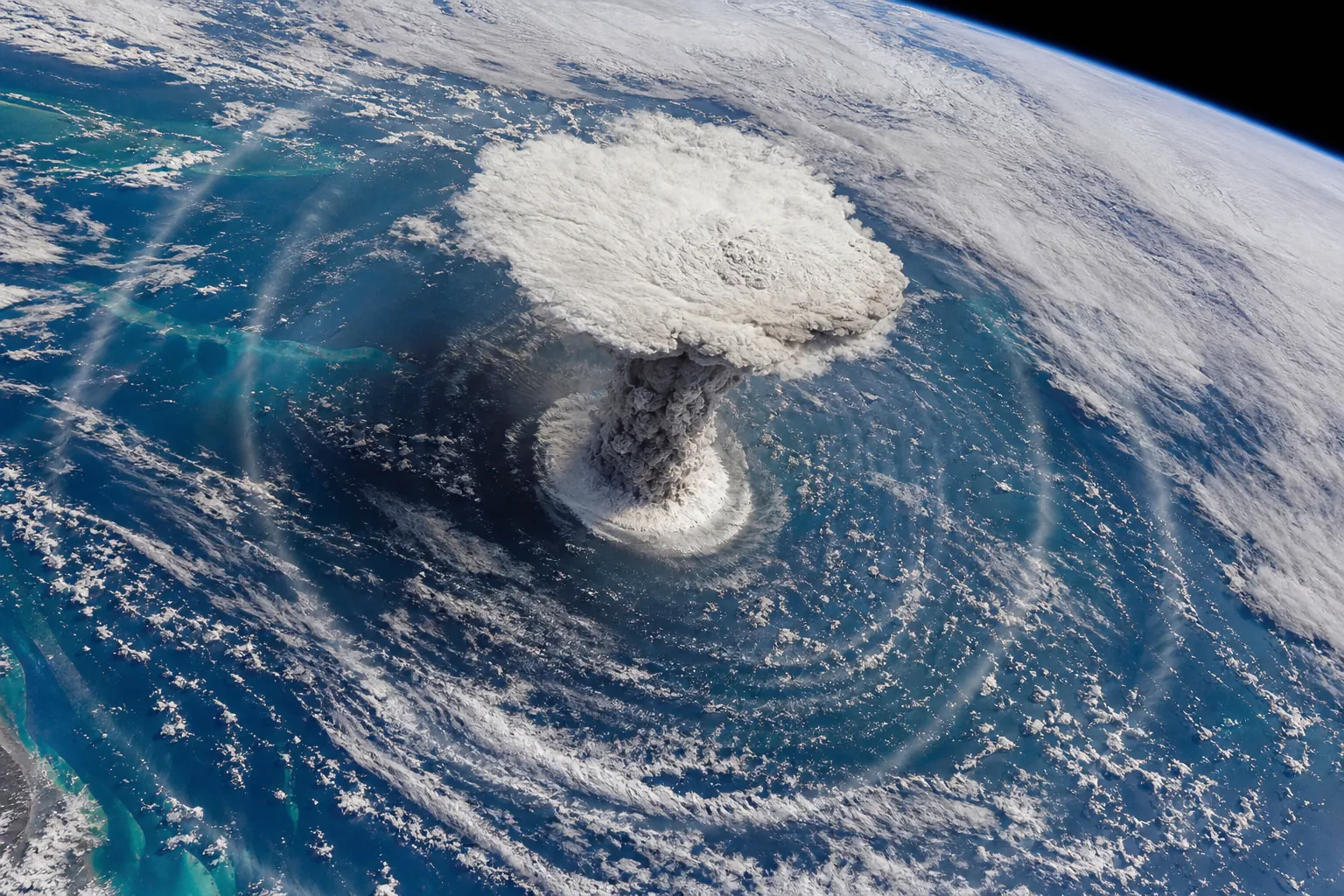
A hybrid network: thousands of cheap ears, plus a few golden ones.
HERD's whole bet is cheap × ultra-dense × cloud AI. The next step doesn't change that bet — it sharpens it. Alongside the dense grid of low-cost sensors, we want to place a handful of research-grade reference stations — "anchors" — on remote ocean islands, facing the open sea, feeding the very same cloud brain.
The idea
Two tiers, one brain.
Today's design is one honest microphone in a choir — a $25 barometer node, repeated hundreds of thousands of times. A hybrid network keeps that choir and adds a few perfectly-tuned soloists: rare, expensive, research-grade instruments that give the cloud a source of truth to learn from.
Tier 1 · Today
The dense cheap network
Hundreds of thousands of low-cost nodes along the populated coast. This is where coverage, redundancy and localization live — an event is real when it's phase-coherent across ~200 km of coastline, and only a dense grid can see that geometry. This tier stays the heart of the project.
Tier 2 · Next
A few reference anchors
Two or three ultra-sensitive, calibrated microbarometers on remote outer islands, out where the open ocean is heard first. Autonomous — solar power, satellite uplink, sealed against the sea. Rare and precise, not dense: a ground-truth reference, not a replacement for the grid.
Density gives coverage. The reference gives precision. Neither tier does the other's job — and that's exactly the point. The dense network can localize a source because there are thousands of it; the anchor can hear frequencies and clean signals the cheap sensor never will. The cloud fuses both.
What an anchor is
An autonomous listening station, alone on an island.
A remote island has no grid, no Wi-Fi, no one to service it for months, and salt in the air. The anchor has to live on its own — a very different machine from the mains-powered home node.
☀️
Runs on sunlight
A fixed solar panel and a rugged battery buffer carry it through a run of cloudy monsoon days. No moving parts to track the sun — moving parts are points of failure.
🛰️
Talks over satellite
Infrasound is tiny data. A satellite uplink carries compressed summaries and heartbeats from the middle of the ocean; the full record is stored locally and back-filled when a link opens.
🎚️
Research-grade ear
A calibrated scientific microbarometer with a known transfer function and a wind-noise filter — an instrument accurate enough to be the yardstick the whole cheap network is measured against.
The outer islands are the first land an open-ocean signal ever reaches — the natural place for a forward reference station, out ahead of the populated coast.
Why it matters
Three things a reference anchor adds.
1 · Earlier & cleaner
Sitting out to sea, ahead of the crowded coast, an anchor meets the source event's atmospheric signal sooner and with less local noise — a higher-quality first look at the wavefront (the kind of atmospheric wave that outran the 2022 Tonga tsunami by hours).
2 · Reaches the deep low notes
A research-grade instrument can hear into the milli-hertz band — the extremely-low-frequency territory of tsunami waves that consumer MEMS barometers physically cannot reach. The anchor covers what the cheap sensor never could.
3 · Ground-truth for the AI
A calibrated anchor is a source of truth the cloud neural network learns from — teaching it to reject wind, denoise, anchor amplitudes and independently check the network's detections. The cheap grid brings numbers; the anchor brings accuracy.
2022, Hunga Tonga: the eruption's atmospheric pressure wave outran the tsunami and circled the planet — the strongest, most valuable signal mode, and exactly what a sea-facing reference station is built to catch cleanly.
How it fits together
One cloud, two kinds of input.
Every anchor speaks the same language as a home node: a UTC-timestamped stream of pressure, disciplined to the same GPS pulse so the cloud can cross-correlate every station against every other. The difference is that the anchor is flagged as a reference tier, carrying its calibration in its metadata.
Inside the cloud, the two tiers do complementary work. The dense grid contributes coherence, geometry and localization across huge numbers of stations. The anchor contributes signal-to-noise, calibration and the low-frequency band. A single detector — the same class of neural network the project is built around — takes both inputs and produces one honest read of what the ocean and the mountains are doing.
Where we honestly are — read this
The anchors complement the network; they do not replace it. The bet stays cheap × ultra-dense × cloud AI. The dense grid is the instrument; the anchors calibrate and extend it.
Two or three anchors can't localize an event by themselves. Localization and azimuth are properties of the dense network — they come from thousands of stations, not from a few points. An anchor makes the signal cleaner and reaches lower; it does not turn a handful of points into a direction-finder.
"Earlier and cleaner" means the source event's atmospheric signal — not a single instrument "hearing the tsunami wave itself" at the shore. We don't over-promise: no sensor on this network hears the tsunami directly. We hear what the event radiates into the air, ahead of the water.
This is Phase 2 — after Proto-1. The first job is a working cheap node. Only once that exists do we build the first anchor. This page is the roadmap and the sponsor invitation, not a product that ships today.
Podcast
Ears of an elephant — the whole idea, in 8 minutes.
An audio deep-dive into this page: why thousands of cheap "ears" need a few perfect ones, what a reference anchor actually does, and where the honest limits are. The discussion is AI-generated (NotebookLM) from our working documents and reviewed by the team.
The path
Strictly after the first cheap sensor works.
We won't spread resources thin. The anchor program starts only when Proto-1 — the low-cost node — is proven. Then, step by step:
Gate
Proto-1 works
A working, validated cheap node comes first. Everything below waits on it.
Step 1
Anchor spec & instrument
Agree the autonomous-station design with our engineer; select and order one research-grade reference instrument with its calibration certificate.
Step 2
First anchor, field-tested
Build one autonomous station — solar, battery, satellite uplink, local buffer, UTC sync — and prove it on a single island through a monsoon season.
Step 3
Two or three anchors
Scale to a small set of anchors on spaced islands, live in the cloud alongside the dense grid — the hybrid tier in production.