聆听次声波,并不是"架一个麦克风"那么简单。信号微弱,背景噪声巨大,而最大的敌人是风。几十年来,一套成体系的技术逐渐成形,其核心是为监测核试验而建立的国际网络。
一张聆听整个地球的网络
全面禁止核试验条约组织(CTBTO)部署了国际监测系统(IMS)——遍布世界各地、连续运转的数十个次声台站。1 正是这套系统捕捉到了车里雅宾斯克流星和汤加产生的声波,2 更早之前还捕捉到了 2004 年苏门答腊海啸的次声波。3 它的直接用途是捕捉核爆炸:朝鲜 2017 年地下核试验的次声波,被 400 公里外的一个台站记录到。6 而如今,次声波已被常规地用于追踪世界各地的火山。7 针对爆发性火山喷发的实用化次声预警系统已经存在(Ripepe et al., 2018),12 例如那张曾对 2019 年斯特龙博利火山的阵发性喷发发出预警的密集地震-声学网络(Ripepe et al., 2021)。13
微气压计与阵列
台站的核心是微气压计,一种能测量极微小压力波动(帕斯卡的零头)的仪器。单个传感器提供的信息很有限,因此人们把它们组合成阵列:几台仪器相隔数百米布设。通过比较声波到达不同传感器的零点几秒的时间差,就能推算出它来自何方、以何种速度传播——从而把真实事件与随机噪声区分开。
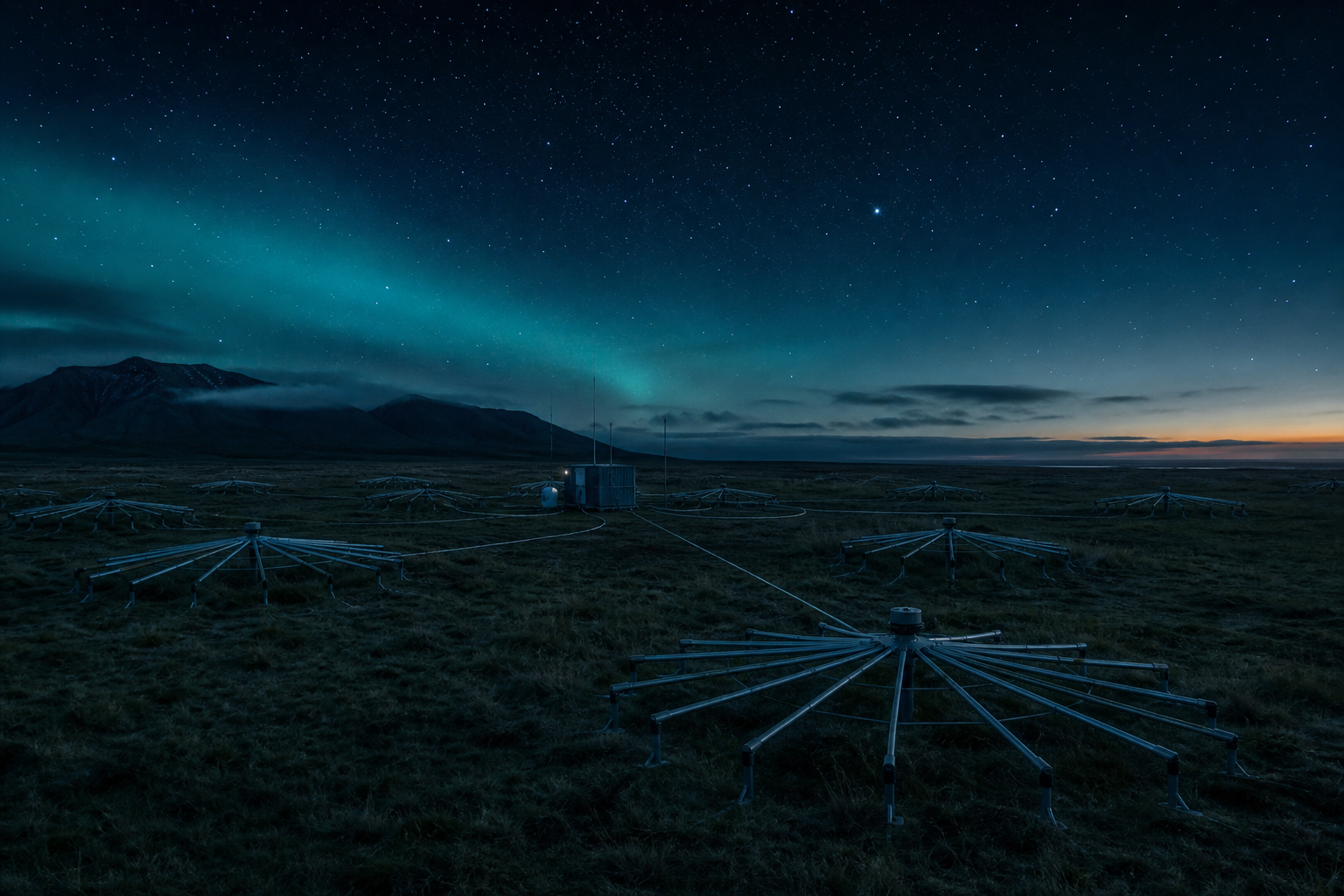
最大的敌人是风
风的湍流会在传感器处直接制造出虚假的"压力噪声"。为了抑制它,每台仪器都配有管阵(抗风噪莲座式滤波器):它们在一片区域上对压力取平均,抑制局部阵风,只留下相干的声波。这是野外次声技术的关键诀窍之一:测量表明,一个直径 18 米的莲座式滤波器能把风噪降低 15–20 分贝。5
信号与天气噪声之争
风并不是唯一的"骗局"。一道经过的大气锋面,会在许多台站上产生相干的压力变化——这恰恰是算法所寻找的东西,因此把地球物理次声与天气噪声区分开来,是一个真实的科学难题。它无法"凭肉眼"解决:阵列相关方法 PMCC 会检验各传感器之间的时延是否与单一的平面波相一致,并剔除不符合的部分。8 对 IMS 数据的大规模分析表明,在实践中如何把非相干的风噪与"伪相干"信号区分开,以及如何计算网络真实的探测能力。9 现代阵列越来越多地利用机器学习和深度学习来对次声信号进行分类(Bishop et al., 2022)。10
大科学已经在昂贵的台站上验证了原理。我们的任务,是把同样的思想(阵列、抗风滤波、相关分析)搬到廉价的节点上,并以数量取胜。这正是下一篇文章的主题 →
本文参考来源
这些来源属于HERD 完整资料库——363 个核实来源,支持按含义搜索和主题筛选。
- 机构 CTBTO. Infrasound monitoring (International Monitoring System). ctbto.org
- 同行评审 Matoza R.S. et al. (2022). Global seismoacoustic observations of the January 2022 Hunga eruption, Tonga. Science 377. science.org
- 同行评审 Le Pichon A. et al. (2005). Infrasound associated with 2004–2005 Sumatra earthquakes and tsunami. GRL 32. agupubs.wiley.com
- 同行评审 Marchetti E. et al. (2015). Infrasound array detection and front velocity of snow avalanches. NHESS 15. nhess.copernicus.org
- 同行评审 Hedlin M.A.H., Alcoverro B., D'Spain G. (2003). Evaluation of rosette infrasonic noise-reducing spatial filters. J. Acoust. Soc. Am. 114(4). doi.org
- 同行评审 Assink J.D., Averbuch G., Shani-Kadmiel S., Smets P., Evers L. (2018). A seismo-acoustic analysis of the 2017 North Korean nuclear test. Seismol. Res. Lett. 89(6). geoscienceworld.org
- 同行评审综述 Fee D., Matoza R.S. (2013). An overview of volcano infrasound: from Hawaiian to Plinian, local to global. J. Volcanol. Geotherm. Res. 249. doi.org
- 同行评审 Cansi Y. (1995). An automatic seismic event processing for detection and location: the PMCC method. GRL 22(9). doi.org
- 同行评审 Vergoz J. et al. (2022). IMS infrasound data products for atmospheric studies and civilian applications. Earth Syst. Sci. Data 14. essd.copernicus.org
- 同行评审 Bishop J.W. et al. (2022). Deep learning categorization of infrasound array data. JASA 152(4). doi.org
- 同行评审 Brissaud Q. et al. (2021). The first detection of an earthquake from a balloon using its acoustic signature. GRL 48. doi.org
- 同行评审 Ripepe M. et al. (2018). Infrasonic early warning system for explosive eruptions. JGR Solid Earth 123. doi.org
- 同行评审 Ripepe M. et al. (2021). Dense seismo-acoustic network warning of the 2019 paroxysmal Stromboli eruptions. Sci. Rep. 11. doi.org
- 综述 Christie D.R., Campus P. (2010). The IMS Infrasound Network: Design and Establishment of Infrasound Stations. In: Infrasound Monitoring for Atmospheric Studies (Springer). doi.org
- 综述 Marty J. (2019). The IMS Infrasound Network: Current Status and Technological Developments. In: Infrasound Monitoring for Atmospheric Studies, 2nd ed. (Springer). doi.org
- 综述 Brachet N., Brown D., Le Bras R., Cansi Y., Mialle P., Coyne J. (2010). Monitoring the Earth's Atmosphere with the Global IMS Infrasound Network. In: Infrasound Monitoring for Atmospheric Studies (Springer). doi.org
- 同行评审 Green D.N., Bowers D. (2010). Estimating the detection capability of the International Monitoring System infrasound network. Journal of Geophysical Research: Atmospheres 115(D18). doi.org
- 同行评审 Le Pichon A., Ceranna L., Vergoz J. (2012). Incorporating numerical modeling into estimates of the detection capability of the IMS infrasound network. Journal of Geophysical Research: Atmospheres 117(D5). doi.org
- 同行评审 Le Pichon A. et al. (2015). Incorporating atmospheric uncertainties into estimates of the detection capability of the IMS infrasound network. The Journal of the Acoustical Society of America 137(3). doi.org
- 同行评审 Matoza R.S. et al. (2017). Automated detection and cataloging of global explosive volcanism using the International Monitoring System infrasound network. Journal of Geophysical Research: Solid Earth 122(4). doi.org
- 同行评审 Ceranna L., Le Pichon A., Green D.N., Mialle P. (2009). The Buncefield explosion: a benchmark for infrasound analysis across Central Europe. Geophysical Journal International 177(2). doi.org
- 同行评审 Ottemoller L., Evers L.G. (2008). Seismo-acoustic analysis of the Buncefield oil depot explosion in the UK, 2005 December 11. Geophysical Journal International 172(3). doi.org
- 同行评审 Evers L.G., Siegmund P. (2009). Infrasonic signature of the 2009 major sudden stratospheric warming. Geophysical Research Letters 36(23). doi.org
- 同行评审 Bowman D.C., Albert S.A. (2018). Acoustic event location and background noise characterization on a free-flying infrasound sensor network in the stratosphere. Geophysical Journal International 213(3). doi.org
- 综述 Johnson J.B. (2019). Local Volcano Infrasound Monitoring. In: Infrasound Monitoring for Atmospheric Studies, 2nd ed. (Springer). doi.org
- 综述 Le Pichon A., Blanc E., Hauchecorne A. (eds.) (2019). Infrasound Monitoring for Atmospheric Studies (2nd ed.). Springer, Cham. doi.org
- 机构 EarthScope Consortium (formerly IRIS) (2024). EarthScope Consortium - seismic and infrasound facilities and open data (SAGE). earthscope.org. earthscope.org
- 机构 EarthScope / IRIS Data Management Center (2024). IRIS DMC (EarthScope) data services - open seismological and infrasound waveform archive. ds.iris.edu. ds.iris.edu
HERD (2026). 如何捕捉次声波. HERD — 次声波资料库. https://theherd.network/infrasound/zh/monitoring