资料库 → 次声波的来源
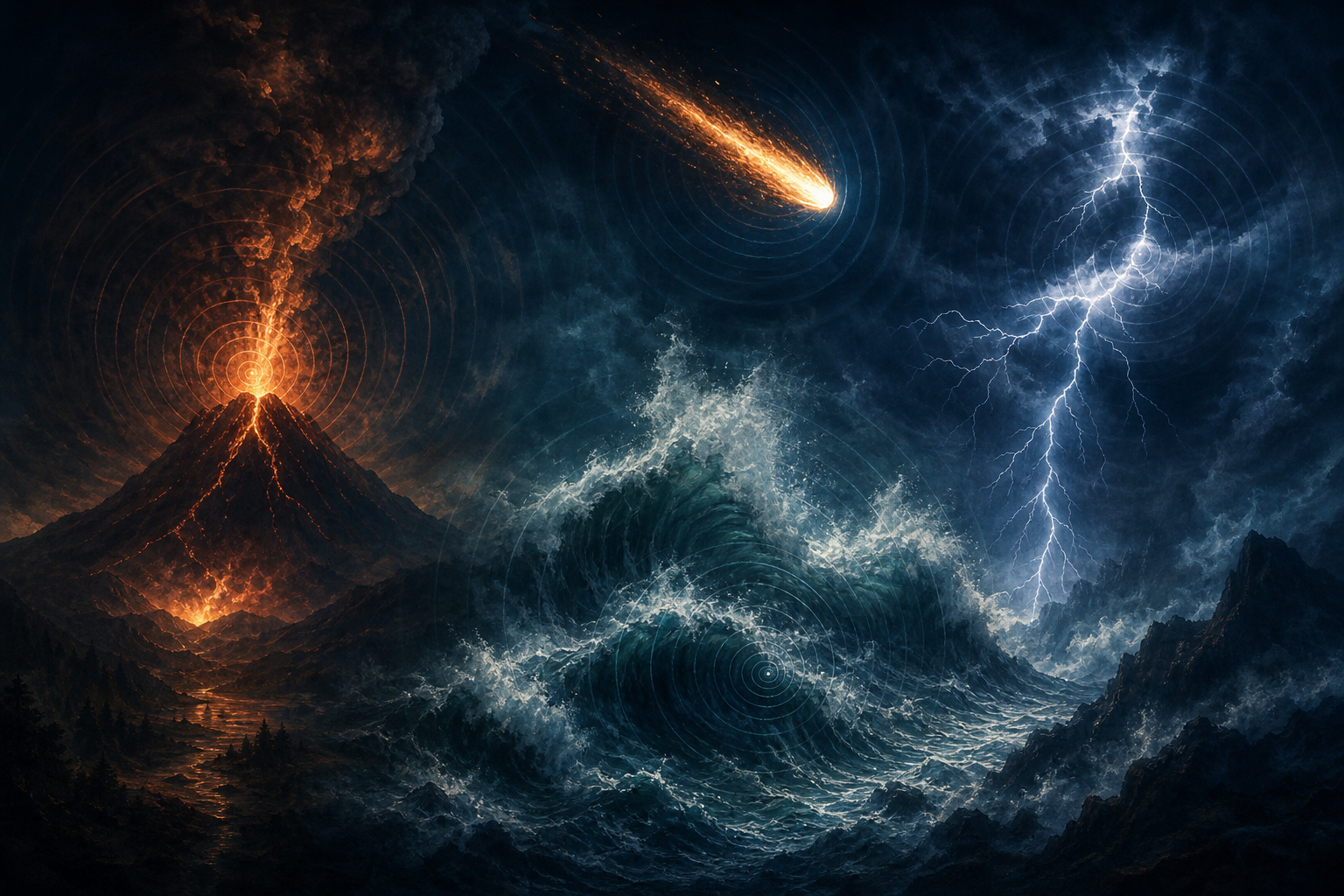
任何足够大而缓慢的运动都会产生次声波:大地的颤动、波浪的碰撞、风暴的涡旋、气流的流动。有些来源是自然且持续不断的,有些只出现几分钟,有些则由人类制造。弄清"是谁在发声"很重要:要听见一个危险事件,你必须能把它从背景的"合唱"中分辨出来。
自然来源
- 🌋火山与地震。火山喷发是最强大的来源之一;2022 年洪阿汤加(Hunga Tonga)产生的声波被全世界的仪器捕捉到。1 用次声波追踪火山如今已是一门成熟的学科。6
- 🌊海洋。风暴期间相向传播的波浪相互碰撞,产生"微气压波"——一种约 0.2 赫兹、持续不断的嗡鸣。2
- ⛈️雷暴与龙卷风。强烈的涡旋会辐射次声波,有时早在龙卷风触地之前。4
- ☄️流星。进入大气层的火流星会产生强大的冲击波(参见车里雅宾斯克)。3 从次声信号的形状,可以估算出该天体以 TNT 当量计的能量。7
- 🏔️雪崩、瀑布、掠过山脉的风。这是一种持续不断的地球物理背景。
人为来源
人类在低频上同样喧闹:采石场爆破、火箭发射、超音速和普通飞机、大型机械、风力涡轮机以及整座城市。对监测系统而言,这些都是必须滤除的"干扰";而对核试验监测来说,它们恰恰相反,正是目标信号。5
主要难点
所有这些来源会同时发声。把"真实事件"从海洋、天气和机械的背景合唱中分离出来,是核心的科学挑战。由多个传感器组成的阵列,以及考察声波来自何方、以何种速度传播的算法,对此有所帮助。
你知道吗?
- CTBTO 监测网能"听见"数千公里外的火箭发射和大型采石场爆破——并能把它们与地震区分开。
- 就连极光也会在次声中"发声":脉动极光产生的高视速度次声曾在阿拉斯加费尔班克斯被记录到(Wilson & Olson, 2005)。
- 地球上最持续不断的来源是海洋:微气压波从不沉寂。
这对 HERD 为何重要
我们的网络要学会在地球持续不断的嗡鸣中识别出危险事件的"特征"。我们对来源了解得越透彻,就越能精确地捕捉到真正重要的东西。
本文参考来源
这些来源属于HERD 完整资料库——272 个核实来源,支持按含义搜索和主题筛选。
- 同行评审 Matoza R.S. et al. (2022). Global seismoacoustic observations of the January 2022 Hunga eruption, Tonga. Science 377. science.org
- 同行评审 Waxler R., Gilbert K.E. (2006). The radiation of atmospheric microbaroms by ocean waves. JASA 119(5). pubs.aip.org
- 同行评审 Le Pichon A. et al. (2013). The 2013 Russian fireball largest ever detected by CTBTO infrasound sensors. GRL 40. agupubs.wiley.com
- 同行评审 Bedard A.J. (2005). Low-frequency atmospheric acoustic energy associated with vortices produced by thunderstorms. Mon. Wea. Rev. 133(1). journals.ametsoc.org
- 综述 Bedard A.J., Georges T.M. (2000). Atmospheric Infrasound. Physics Today 53(3). physicstoday.aip.org
- 同行评审综述 Fee D., Matoza R.S. (2013). An overview of volcano infrasound: from Hawaiian to Plinian, local to global. J. Volcanol. Geotherm. Res. 249. doi.org
- 同行评审 Edwards W.N., Brown P.G., ReVelle D.O. (2006). Estimates of meteoroid kinetic energies from observations of infrasonic airwaves. J. Atmos. Sol.-Terr. Phys. 68. doi.org
- 同行评审 Wilson C.R., Olson J.V. (2005). High trace-velocity infrasound from pulsating auroras at Fairbanks, Alaska. GRL 32. doi.org
- 综述 Johnson J.B., Ripepe M. (2011). Volcano infrasound: A review. Journal of Volcanology and Geothermal Research 206(3-4). doi.org
- 综述 Silber E.A., Boslough M., Hocking W.K., Gritsevich M., Whitaker R.W. (2018). Physics of meteor generated shock waves in the Earth's atmosphere - A review. Advances in Space Research 62(3). doi.org
- 同行评审 Mutschlecner J.P., Whitaker R.W. (2005). Infrasound from earthquakes. Journal of Geophysical Research: Atmospheres 110(D1). doi.org
- 同行评审 Farges T., Blanc E. (2010). Characteristics of infrasound from lightning and sprites near thunderstorm areas. Journal of Geophysical Research: Space Physics 115(A6). doi.org
- 历史 ReVelle D.O. (1976). On meteor-generated infrasound. Journal of Geophysical Research 81(7). doi.org
- 综述 Campus P., Christie D.R. (2010). Worldwide Observations of Infrasonic Waves. In: Infrasound Monitoring for Atmospheric Studies (Springer). doi.org
- 同行评审 Gi N., Brown P. (2017). Refinement of bolide characteristics from infrasound measurements. Planetary and Space Science 143. doi.org
如何引用 · 复制
HERD (2026). 什么产生次声波. HERD — 次声波资料库. https://theherd.network/infrasound/zh/sources